Showing posts with label Mountney. Show all posts
Thursday, November 14, 2019
More about my lost Frosts... and why we need to keep on remembering our history
I'm still trying to trace my little family of Lost Frosts: Eliza nee Worthy and her children Elizabeth, Maria, and Richard junior. Still no luck: they vanished into thin air, changed all their names, were kidnapped by aliens, emigrated under pseudonyms, or just slipped away into the shadows or lost census pages. (I discovered that I cannot find Eliza or her Worthy parents and siblings in the 1861 census because the pages that document the part of Lewin street that they were most likely living on (5 Lewin Street) have been lost: they are missing from all online copies.)
What I have found is two more daughters born to Richard Frost and Eliza nee Worthy: Elizabeth (their first Elizabeth) born 5th January 1871, and Clara born at the very end of 1871 or early in January 1872. This newly-discovered Elizabeth died, only thirteen days old, from convulsions. Clara, who must have been conceived very quickly after sister Elizabeth, little darling, lived until she was five years old... and then scarlet fever killed her, right around the time that her little sister Maria was born. What tragedy for the parents.
I found no other babies between Eliza's marriage to Richard, and his death in 1882. But there are two-year gaps between the other children, and no child at all after Richard Junior's birth in 1878: I'd bet there were miscarriages in the gaps, or unregistered births and deaths.
This is the ongoing story of family history research. My ancestors were poor, all of them, all except a very very few, like one or two generations of Mountneys before they became scoundrels on canal boats, and shepherd William North of Seagrave who had a cottage and a horse to bequeath to his children, or the farmer Bonnetts of Whitwick who had their own tragedies after John contributed to my tree. There are no ancestral knights in shining armour, no "blue blood", no hidden riches. They were hardworking people: blacksmiths and bootmakers and shoe finishers and framework knitters; lacemakers and even a milliner (hatmaker). They fought for the country and were lucky and escaped, most of them, with their lives, their bodies and minds never forgetting.
One thread runs through it all, from the 1500's until last century, the century I was born in: huge families, many children, and so very many - far too many - infant and childhood deaths. So many parents lost way too young, their bereaved partner then finding someone else to help raise the kids. Multiple births and multiple losses; children fading after a parent dies; health problems due to their occupations; parish records with page after page of burials for "an infant", "child of", or aged under 30.
What changed in the 20th century? Several things: first and foremost, the National Health Service, making health care available to everyone, no matter how poor, no matter if they lived in the industrial city streets or in little villages. Equality in voting and election process for women. Schooling continuing into late teens, enormous progress in workers rights and safety at work - made even stronger by the common rules of the European Union. The availability of contraception to those who want it, and sex education for all. And yet... today it feels like the world wants to turn the clock back.
Has everyone forgotten where we all came from?
Before you go and cast a vote for someone who swears they represent you, yet will convert your healthcare to a for-profit business, or will strip away the workers' rights today guaranteed by law, think about what your ancestors too experienced. Remember those who had babies, each and every year, and lost half of them. The parents - men and women alike - who worked until they dropped, including those who managed to survive until their 70's and 80's, because they had no pension to survive on. The families living ten to a room, without the heating and electricity that we take very much for granted today.
They deserve a vote, too. Don't mess it up.
Friday, July 14, 2017
Mountney Mischief: a tale of canal boats, missing salmon, and a stolen ass
| A few of my Mountney ancestors |
I imagine them on longboats, lying on their backs, moving the boats through canal tunnels using only their legs. I imagine brightly-painted boats, when they were probably covered in coal dust. I imagine the Mountneys as rough scoundrels, hard-working-and-hard-fighting men, with little time for women's frills and lace...When my great-grandmother Sarah Anne was 14 years old, in 1871, she was back in Leicestershire, staying with her maternal grandparents, the Goulds of Great Dalby, and working as a domestic servant. She later met and married George Riley of Queniborough, tying the knot on Christmas Day, 1875.
I don't know why Sarah Anne went to stay with her grandparents... maybe she was being saved from the mischief cooked up by her brothers. (When her grandfather, John Gould died in 1872, he left Sarah Anne a legacy of five pounds to be given to her at 21 years of age. There is no explanation in the will as to why she was singled out for this.)
Sarah Anne was the eldest child, and her siblings were William, John, Henry, Mary Elizabeth, and George, all born between 1859 and 1865, all in or near Birmingham, Warwickshire. Mary Elizabeth returned to Leicestershire too, living in Queniborough in 1881, where she worked as a housemaid at The Coppice: the big house at the end of the very-same long avenue of horse-chestnut trees, Coppice Lane, where my dad often took my sisters and I to collect conkers! By 1887, Mary Elizabeth was in Philadeliphia, USA, married to Alfred Woolston of Rothley, Leicestershire. Another mystery: I'd love to know what drove their emigration... a desire for a new life in a new country. or a business opportunity, or horses? (Alfred was a groom.) Or... further away from the naughty Mountney brothers!
And why do I think they were so naughty?
- William and John were sent to trial for larceny in 1878, and received sentences of eight months and six months. I think this was for the theft of four cases of salmon from the London and North Western Railway (here's a transcript of the newspaper article in the Birmingham Post, see article 658. Thanks to http://www.spellweaver-online.co.uk)
- John came out of jail and then went back in, in 1879, this time charged with petty larceny and being asked to serve four more months inside (I haven't found the crime, yet)
- And Henry? Henry... in 1879, our Henry was in Brownhills' prison, Birmingham, Warwickshire, for committing simple larceny after a previous conviction for a felony. At 17!!! Guess what he stole. It's OK, they recovered the property. An ass. He stole an ass.
The Birmingham Police Gazette newspaper stated that Henry was "fresh-faced", all of 5' 5" tall (without shoes), with grey eyes, slender build, and a cut mark near his right eye. Henry said that he had recently been at the Dog and Gun public house in Belgrave, Leicester, but it's not clear whether he was so drunk that he stole the ass by mistake, or if he had missed his boat and decided to take the ass instead of walking the long way home to Birmingham. Whatever the reason, there he was, in jail, a villain with a scar near his eye.
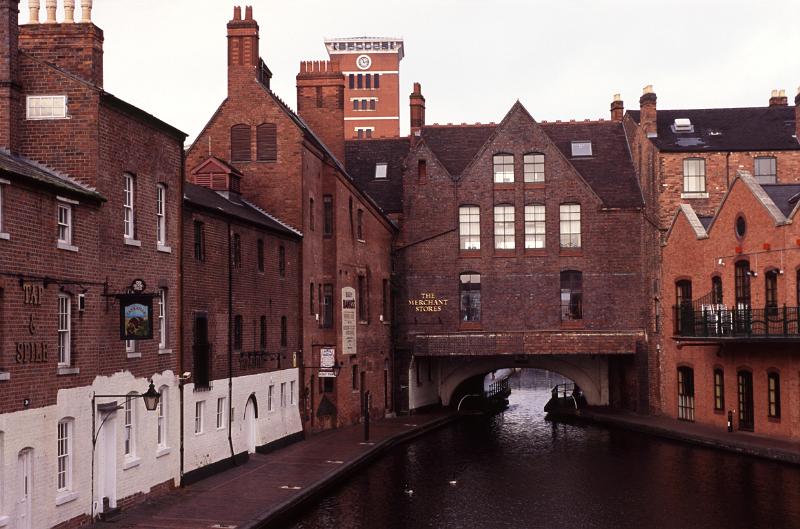
| Birmingham Canal. Image by PhotoEverywhere.co.uk |
But Henry made good. At least, he tried. On 15th August, 1881, Henry signed up to join the Leicestershire Regiment. He'd grown 3/4" and now measured five feet, five and three-quarter inches tall, weighed 140 pounds, and had the blue-grey eyes that many of the Toon family have today, myself included. He had light brown hair, and was considered fit to sign up and serve Her Majesty (Queen Victoria) for twelve years (seven years in Army service, five in the Reserves). He served in Malta, Egypt and Gibraltar. Apart from a few days AWOL and an incident of "resisting" early in his service in 1881, his conduct was noted as good by his commanding officer, according to his military paperwork. He was transferred to the Oxfordshire Light Infantry in 1882, and then to the South Staffordshire Regiment in August of the same year, which is where, as far as I can see, he remained. Henry received a medal for his participation in the Egyptian campaign of 1884-5. Henry was released to the Reserves on 18th May, 1889, and then discharged from service on August 8th, 1893. He did, indeed, serve a full 12 years.
In April, 1890, Henry had married Ann Grimmett nee Butler, a widow who had already given birth to three children: a daughter, Anne Grimmett, and two sons, Joseph and William. Anne was several years older than Henry, and as far as I know, they did not have any children together. They lived on Tyndal Street in Birmingham, with Henry back to his trade as a boatman... but on 24th May, 1902, our Henry was arrested in Hopwas, Staffordshire, for being drunk and disorderly, and fined 5 shillings plus costs, according to the Tamworth Herald newspaper. Hopwas is on the Birmingham and Fazely Canal and had the usual canal-side public houses. You can't keep a good man down.
Henry passed away in late 1918, in Birmingham, aged 56. I bet he still carried a sparkle in his blue-grey eyes.
,
There are some wonderful stories about boatmen, and the canal boat life, including more villany, here on Spellweaver. Congratulations to Alan and Angela for pulling all of this information together--the newspaper articles are so very helpful!
(Note: Mounteny is a name that is often spelled differently, or is incorrectly transcribed. I've found Mountneys, Mounteneys, Mountains, Mauntenys... and they are not all found with a "similar" search.)
Thursday, July 13, 2017
Tracing the family tree; who, what, how, and why?
When I first started seriously researching my family tree, it was many years ago, before FamilySearch.org, before Ancestry.com, way before FindMyPast.co.uk. I lived in France, and all my family, and family history, was in England. I wrote letters and put them into paper envelopes with stamps on, and trusted them to the postal services. I tried to gather information from aunts and uncles, and I engaged the services of a nice gentleman in England who would nip off to the Registry Office to track down and purchase birth, marriage and death certificates.
As the internet started to grow, I found people through LISTSERVS and online forums who were chasing their own roots. When I moved to the USA, I discovered the amazing microfiche libraries maintained and shared by the Mormon church through their Family History Centers, and spent many a long our staring into a reader in a darkened room, trying to decipher handwriting on deteriorated paper which had been photographed in less-than optimum conditions.
Over time, the online repositories and search engines have blossomed into a wonderful store of knowledge. TV programs promote the myth that it's easy to trace your way back to a King or Queen. And DNA testing connects you with people whom share genes from a common ancestor, maybe five or six or more generations ago. My own DNA shows 83% "Great Britain" and most of the rest Scandinavian... so there's probably a Viking or two in there way back, but little or no French, Gypsy or Irish in the mix... much to the opposite of the stories about the Bonnetts!
One of the triggers to starting my research was the desire to find out more about my mother's maternal ancestry. As the youngest child of a large family, whose mother passed away just days after she was born, she knew very little about her mother's family--the Bonnetts--other than family rumours. The Bonnets' proved to be the most difficult of my grandparents' ancestry to trace, and yet one of the most fascinating. You'll see that name again, along with Toon, Carvell, Mountney, Riley, and many more. The Hughes family--the family of my daughters' father--is another fascinating branch, with many stories to tell.
While my "tree" is public on Ancestry.com, under the username alisontoontree201009, this website will share the stories of some of the family, and some of my experience and learnings while researching.
I encourage everyone to find out more about their ancestry. Our forefathers have shaped us into who we are, for better and for worse. If you know where you've come from, you have a better chance of knowing where you're going.
I go from researching families with ten or fifteen children, living in small homes, starting work at 12 years old or worse, working in factories or as domestic servants or farmhands or down in the dark of a mine, to my other guilty secret--House Hunters on HGTV--and see spoiled people refusing a house because each child doesn't have their own bathroom... The family research helps keep me sane in this consume-all world.
What would my great-grandmother say to my kitchen and laundry room? All the bedrooms? All this space for so few people? Would she complain that she doesn't have two walk-in closets and a personal dressing room? Somehow, I don't think so.
It's all relative!!!
Subscribe to:
Posts (Atom)
-
Honeycomb tripe image shared under Creative Commons licensing There are a couple of more unusual family names that wind in-and-out of m...
-
Marriage of Frederick Charles Blankley and Eliza Smith, 13 June 1880 by kind permission of FindMyPast.com (If you didn't read part ...
-
An idea of the travels of Frederick and Eliza Google Maps (If you didn't read part one, start here. Part two, here .) By combi...