Sunday, November 19, 2017

Can anyone date this photo, or name the photographer? Syston in Leicestershire, England

Undated photo of Syston High Street from Pinterest (c) whoever owns the copyright
The photo is of the centre of Syston, Leicestershire, looking down High Street, the Fox and Hounds on the right, a water trough where the memorial was later placed and even later removed. The tall house on the right would one day become Todd's chemists' and then eventually morph into another business.

I wonder who the people are. Who the children grow up to be. Who their parents are. And what that strange device is in the middle of the street.

This photo was found on Pinterest here. I have used an image search to try to find the origin, with no success. It's not one of the Francis Frith collection--it is from way earlier than that, possibly from the time of this story about the butchers of Syston, and what happened in the Fox and Hounds, and it looks like it might even have been taken on the same day as the print that I have in my own collection, whose origin too is unknown. The boys are wearing the same white collars. The window boxes on the pub look the same. The awning over what-would-become-Todd's-where-I-would-later-work is open in both photos.

Can anyone identify the date, or the photographer, or another copyright holder? I would very much like to attribute the photo ASAP.

Does anyone have a higher-resolution scan of the original--this one pixellates when you try to zoom in, and I'd love to have a go at restoring it a little more. Contact me if you have any more info.

Friday, November 17, 2017

Willey Toon, Annie Cook, and the painters of Syston (part two)

If you haven't read the other parts of this story, begin here at Part One.

On 3rd April 1881, William -- I'll call him William from now on -- was living at home with his dad Richard, on Brook Street in Syston. Less than a year later, in February 1882, William was living on Northampton Street (or does it say Southampton Street?) in Leicester, a couple of doors away from his wife-to-be, Annie Cook, and they were married at Saint George's Church in the city of Leicester. At first glance, it looks like neighbours who fell in love and married.

That's what I thought, until I remembered to count.


My grandad, Frederick Toon, was William and Annie's firstborn. He was born in Syston, Leicestershire... on 14th March, 1882. Ooops. Yes that's just two weeks after William and Annie were married. Don't ever let anyone tell you that sex-before-marriage only happened after the 1960s. It's just human nature, and by British law, any child conceived or born outside of marriage becomes "legitimate" the moment the parents marry. In case anyone, anywhere is ever still worried about that--which I hope you are not!

Here's Frederick's birth certificate:


So how did William and Annie meet, if they were not simply neighbours in Leicester?

Annie Cook was born on 29th April, 1861, the eldest child of James Cook (1835-1914) and Mary nee Litchfield (1836-1910), in the village of Slawston, on the edge of Leicestershire, Rutland and Northamptonshire, quite a way from Syston. But her father James was a waggoner, driving a horse-drawn cart, possibly delivering goods around the county. Maybe he delivered wool from the farms of rural Leicestershire and Rutland to the new, growing factories in the cities. Maybe he delivered to and from Leicester. Maybe Annie rode with him one day to see the sights, or to look for work, and met her future employer, or maybe her dad arranged the work for her, because in the 1881 census, Annie Cook, born in Slawson, is living in Syston, and working as a domestic servant and cook at Wakefield House on the Fosse Road. She is working in the household of Robert Rowley, a hosiery manufacturer who was born in Wisbech, Cambridgeshire, his wife Elizabeth, and their family of five children. I can't find the house on street maps today. (There is no street number on the census, just the name, which seems to have been forgotten. If you know, please let me know where it was, or is. I wonder if it was 99 Fosse Way, which is now a care home?)

Maybe William Toon was hired to paint the Rowley's house, and there met Annie? That would make sense... But then why were they both living on Northampton Street in Leicester at the time of their marriage, when it seems that all of William's life had been in Syston, Annie was working in Syston, and they were back there in time for Fred's birth?

Maybe Robert Rowley took care of them.

Robert Rowley had also established a business as a young man: his hosiery company was begun in Leicester, on Queen Street, in 1867. (Robert Rowley's father had moved to Leicester from Wisbech with his son, and worked in a wood yard sited on the same street as Robert Rowley's first factory. Was it a Walkers' wood yard? Because that would then connect not only with Annie's job, but also with William's mother, Mary Walker. Saving that idea for another story.)

St George's church, Leicester
St George's Church, Leicester
(c) NotFromUtrecht CC BY-SA 3.0 via Wikimedia Commons
And guess what? Queen Street, where the Rowley factory was, runs parallel to Southampton Street. Queen Street is right next to St George's church. Northampton Street is just on the other side of the church. Northampton (or Southampton) Street is where William Toon and Annie Cook were living on the day of their wedding.

Given that Robert Rowley was, by then, a very wealthy man--he left £813,931 in his estate when he died in 1936--it's quite feasible that he owned property on Northampton and/or Southampton Street, where the two could have been lodged for their wedding banns and marriage, just in time for Fred Toon's arrival. I'm only guessing... but it makes a nice story. A kind and rich benefactor for my expectant, unmarried great-greats.

(The night of 5th October 1911, the timber yard, Rowley's factory, and St Georges' church were all seriously damaged in a huge fire. The business recovered. You can read the story here.)

That's part two of the story: part three coming soon! It includes poison!!!

Click here for Part Three.

Willey Toon, Annie Cook, and the painters of Syston (part one)


For almost anyone who has spent time in Syston, Leicestershire, the name Toon is synonymous with "painter and decorator". (And cricket. Don't forget cricket!) An internet search will still find at least one Toon still involved in the painting trade... over 130 years!

When I was a child, I'd often see Uncle Cecil or Uncle George cycle past, caps on their heads, A-shaped ladders somehow safely tucked under their arms, a bucket of paint on the handlebars... or later, more likely driving a van with the family business name on the side. The house on the Green in Syston had a paint store in the back yard--the old stable--and an office at the front, with all sorts of things that I wasn't allowed to touch. Wallpaper rolls. Grandad Fred Toon's collection of sign-writing inks. He wrote several of the signs in the parish church, all gold calligraphy on black.

Grandad Fred wasn't born until 1882, way too young to have established the company in 1884. The story begins with his father, my great-grandfather, Willey or William Toon, and later with his mother, Annie Cook.

Willey (that's what he was baptised, and how his birth was registered), was born on 24th August, 1860, in Syston, Leicestershire, the youngest son of Richard Toon (1801-1886) and his second wife, Mary Walker (1824-1881). Richard was 58 when Willey was born; his youngest daughter, Mary Matilda, was born two years later. I believe that between Mary nee Walker and his first wife, Catherine nee Cooper, Richard fathered fifteen children, but there may have been one or two more, or one fewer. There's a four-year gap in children between Emma (1851) and Arthur (1855), and given that there had been a child at least every two years during each of his marriages, the gap must tell a story. Also, Fanny Toon, born about 1860, is listed as Richard's granddaughter in the 1871 census, but I haven't yet discovered her parents--she might be his daughter? **Update: Fanny is likely the daughter of son Henry, born 1830, a drum major.

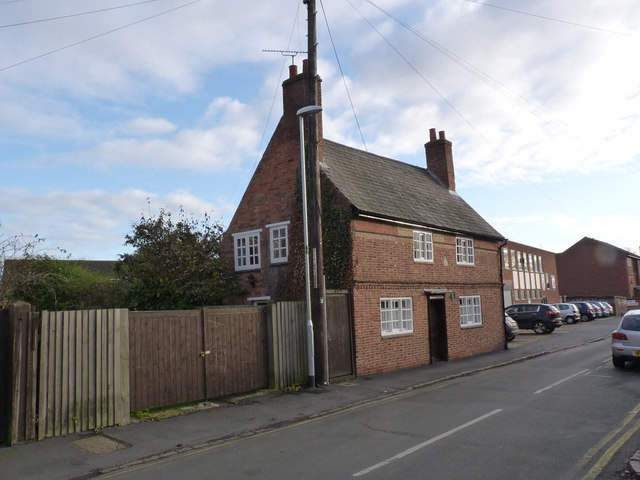
3 Brook Street, Syston, dated 1686.
Photo copyright Alan Murray-Rust (cc-by-sa/2.0)
Richard and his family lived on Brook Street in Syston; Richard was a gardener. I don't know where he gardened, or if he was a flower gardener or a market gardener, but that's the profession that is listed on the censuses.

Most of the houses from that time are gone now, and I don't know the exact location of house on Brook Street where Willey was born (the censuses do not give a house number), but I imagine it was a cottage like this one which still stands at number 3 Brook Street, a small home which housed Richard, his wife, and as many of the children as fit and who had not yet left home. The house would most likely have been thatched: slate roofs were added later.

In 1861, the first time Willey appears on the census, there are five children at home; in 1871, five children of Richard and Mary's, plus Fanny Toon. By 1881, when Willey (now William) is 21 years old, there are only Richard, now a widower again and aged 80, William, daughter Ellen and granddaughter Kate (Catherine) Blankley, aged 22, daughter of Richard's daughter Charlotte (1836-1902) living in the house on Brook Street.

In 1881, William Toon of Brook Street, Syston, is still single and is already working as a painter. That's the beginning of the story of the Toon painters and decorators of Syston, before William marries and raises his own family.

For Part Two, click here!

Tuesday, November 14, 2017

Reaching deep into the past... and aliases, and Latin. I found a Randolphus! And Edwardus!

Frosty sheep in a frosty field - geograph.org.uk - 332840.jpg
Kirby Bellars field by Andrew Tatlow, CC BY-SA 2.0Link
Even though the Toon family line has proven, so far, to be the easiest to trace--they were prolific, and they were very good at registering births, baptizing children, and staying in a very constrained area of Leicestershire--there's a point at which it seems impossible to dig further into the past.

Christopher Toon, my 8th great-grandfather, who married Ana in Kirby Bellars, Leicestershire, England, on 25th November, 1621, is my best example of the historical "brick wall". He and Ana raised a small family in Rotherby: four boys and a girl, before Christopher passed away aged 31. He was buried the same day as his infant daughter Anne (or Anna?) was baptised. Christopher's decendant Toons spent several generations in and near Rotherby, Hoby and then Syston and Asfordby, all within walking or horse-cart distance of Kirby Bellars.

I call him "Christopher", because that's what other researchers have called him, and in the Rotherby records for the birth of his children, it's abbreviated to "Chris". However, the parish record that appears to be for Christopher's marriage names him Xpotferus, or Xpoferus, depending on who did the transcribing... what do you think?


All the names in the Kirby Bellars' parish records for this time are written in a sort of Latin, often with English names made to sound latin by the addition of "-us", for example, "Josephus" and "Edwardus" and "Randolphus". I assume this was for the purpose of the church records only and not that the entire village of Kirby Bellars spoke Latin every day!

Here we have the burial and baptism record, from Rotherby, which is just over three miles from Kirby Bellars. The vicar in Rotherby wrote in plain English, making it easier to understand:


Now I'm stuck at Christopher; haven't yet found any record of his birth, and the parish records from before 1600 are difficult to read, hard to find, or simply don't exist. Even though my earliest family history research began with the Toons, I have made very little progress with Christopher in many years.

Until now.

I decided to instead take another look at Christopher's wife, Ana (Anna? Anne?). She only appears on the marriage record, not in the baptisms of their children, and she has an unusual surname:


"Ana Steele alias Kitchen". What the heck sort of name is that? Why an alias? Was she hiding from someone, and the vicar found it out, and wrote it into the marriage record? (Probably not.) Was she the child of a marriage where the mother remarried, and Ana then carried both her natural father's name and that of her stepfather? (Maybe.) Was it something else entirely? (It's possible.) It seems that "alias" was used in a slightly different way around 1600 than it is today. Don't think Alias Smith And Jones: instead think "otherwise" or "in another time"... or simply, "we want to remember this name". And remember that the vicarus in Kirby Bellarsus was a Latin freak.

Here's an essay about the use of aliases in the UK. It gives five situations in which name-alias-secondname might have been used:
  • Retention of a patronymic, for example to keep grandad's name going
  • Retention of a topographical reference point
  • Commemoration of an ancestor's marriage into a family of good social standing
  • Illegitimacy, where the last part of the name is the unmarried mother's name
  • Other reasons such as inheritance.
Because 'Steele alias Kitchen" couples two names that are not so common--though it brings to mind sharpened knives and a roasted ox--and because now we have access to more records online, I recently started to search further into Ana's history. And found not just Ana, but potentially a whole family of "Steele alias Kitchen" folks.

Some of them are Steele alias Kitchen, then just Steele, or have been transcribed from the same record in multiple ways, depending on who did the transcribing, and what they saw. Most are in Kirby Bellars with the same Latin flourishes to their names, with a few marriages in other parishes a very few miles of Kirby Bellars. Most fit within the typical years of a marriage's childbearing years (apart from a couple of grandchildren). So... given the rather special name, it's possible, and even likely, that these are all Ana's siblings: Richard, Roger, Nicholas, Randolph, Dorothy, and John. With or without a Latin flourish to their names.


I have added all this to my tree on Ancestry.com, together with plenty of CAUTION notes: while the marriages and occasional baptisms are documented, parents' names were not recorded for the marriages, nor mothers' names for the baptisms. This is speculation, based on available knowledge; this is an educated guess. Please, feel free, to knock holes in this logic: it's how we improve our information.

The name Kitchen is written in many ways in the records and their transcripts: Kitchen, Kytchyn,
Kitching, Orkitchin (as "Steel Orkitchin"). Sometimes it's written Kitchen or Steele, rather than Steele or Kitchen. I'll be adding more people to this branch of the tree as I find them.

I will return to the Toons again very soon: for Annie Toon nee Cook's story, and to see if any of you can confirm the parents of Thomas Toon, born in Syston in 1731, died in Syston in 1774, my 4th great grandfather, who I believe was the son of Thomas Toon and Elizabeth Bilson... because if that assumption is wrong, then this story about Christopher Toon and Ana Steele alias Kitchen is someone else's family story!

Friday, November 10, 2017

Close-knit families... Frosts and Bonnetts

Family connections... Frost and Bonnett
That feeling of deja-vu as you start researching a branch of the family, previously untouched? The names, and even more, the pattern of names, feel familiar. It's like you've been there before, from a different angle: opened another window into the same room. Another chapter in the same story. And sometimes, it really is deja-vu: it's a small world.

Bonnetts and Frosts. Sarah Frost, born in Leicester in 1830, the daughter of John Frost and Elizabeth nee Kilby, married Emmanuel Bonnett, born in Barrow upon Soar in 1827, the son of John North Bonnett and Elizabeth nee Lindsey.  Sarah and Emmanuel were my great-great-grandparents, and I've long been following both of their direct family lines.

My great-grandfather, son of Emmanuel and Sarah, was Henry Bonnett. Henry's older brother, John Bonnett, was born in Grantham, Lincolnshire in 1832, when Emmanual was working there and before the family moved close to Birmingham. Both Henry and John worked in the shoe and boot trade, not as blacksmiths like their father and grandfather. John eventually married Mary Ann nee Overton, and their eldest son, William Henry Bonnett, was born in Leicester in 1874.

By the time William Henry was 17, he was working as a shoe finisher, like his father, and the family lived at 74 Martin Street, near Catherine Street. The street still exists: the houses do not. William Henry was the eldest child, and there were at least ten younger siblings, some of whom survived infancy, some who did not.

William Henry Bonnett married Sarah Ann Willson, in Leicester, in 1896, when he was 22 and Sarah was 20. For a long time, that's how I left the family tree, with only Sarah Ann's name and birth year: it wasn't until much later that I started researching Sarah Ann's own heritage.

And guess what? Sarah Ann Willson's mother was Rachel nee Frost. Rachel Ann Frost, born on Woodboys Street in Leicester, 26 September 1844. Her father, James Frost, born in Blaby, Leicestershire in 1815... younger brother of John Frost, father of the Sarah Frost who married Emmanuel Bonnett.

Sarah and Emmanuel's grandson William Henry married Sarah's cousin's daughter, Sarah Ann. It took me a while to figure that out.

I wonder if they met each other through the family, maybe at a wedding or a funeral or some other get-together, or if it was simply because they all ended up living in the same Leicester streets, families mostly working in the shoe and boot trade, with a few blacksmiths and foundry workers in the mix? Another family story to ponder...

William Henry Bonnett and Sarah Ann nee Willson first lived in Leicester, then moved to Cosby, in the Blaby area of Leicestershire, where the family lived on Main Street. They had two daughters: Evelyn, who died young, aged 16; Edith Mary Ann, and one son, William Henry Bonnett, same as his dad.


Friday, September 22, 2017

Did I just break through a brick wall? Elizabeth Durhead. And things come in twos.

Banns for the marriage of Samuel Carvell and Elizabeth Durhead
Elizabeth Durhead, my fourth great-grandmother on my maternal grandfather's side, has had me stuck--a "brick wall"--for almost as many years as I've been researching the tree. She married Samuel Carvell on 22nd April, 1776, in Churchover, Warwickshire, one of a group of villages that straddle the Warwickshire/Leicestershire border surrounding the market town of Lutterworth, and in the area where future generations of Carvells will live and work and grow their families. Churchover, Misterton, Kimcote, Walcote, Costerbach... until great-grandad Samuel Henry Carvell settled in the city, Leicester, after retiring from the army.

Elizabeth Durhead and Sam Carvell had at least eleven children, at least five of whom did not survive their first five years, sadly typical of families of that time. Agricultural labourers, poor, with children arriving one after the other until fertility ended, or the mother died, after which the father often remarried, quickly, for help with all the children.

My ancestor Samuel Carvell, son of Elizabeth's Sam, was the second child born to the couple to be named Samuel. There was a Samuel baptized on 25th April 1778, and then "my" great-great-great grandad Samuel who was baptized on 11th May, 1783. Both baptisms in Churchover, both to parents Samuel and Elizabeth Carvell. I cannot find a record of the first Samuel being buried... so either "my" Samuel was baptised twice and he was older than I think he is, or the first Samuel died and was buried elsewhere, or there were two Samuel and Elizabeth Carvell couples living in Churchover at the same time. That's not impossible; there was definitely a family patter of names for all the children, but I tend to believe that the first Samuel child did not survive.


Anyway... back to Elizabeth Durhead.

There is no record of any Elizabeth with the Durhead surname anywhere in the parish records, not in Warwickshire, nor Leicestershire. In fact, there is nobody, man, woman or child, with the surname Durhead, not anywhere I have searched: not in all of England or anywhere in the world of online records and indexes.(That's not to say that they didn't exist.)

I tried saying the name, Durhead, out loud, and writing it in different ways. I tried many variants on the spelling: Durrhead, Derhead, even Daffyd. I studied the photos of the parish register, squinting and trying to see if there was a different way of transcribing it. No... it still looked like Durhead.

But then... today... I think I might have found her. But... and there's always a but... I didn't find my one-and-only Elizabeth Durhead, but two!!!

There is an Elizabeth Durrad, a variant on the name that I hadn't previously thought of or seen, born in Kimcote in 1754, daughter of Sarah Durrad, a "natural child". That's such a nice way of describing an illegitimate baby whose father's name is not known (or not given). Durrad! Yes it sounds the same as Durhead! The age fits for marrying Samuel. But wait... there is another Elizabeth Durrad, also born in Kimcote, also a natural child, but whose mother's name is Mary Durrad; this Elizabeth was born in 1759.

So now we have two possibilities for a relationship that might be completely incorrect... but for now, I am going to go with Elizabeth the elder, baptized in 1754, as that would make her 22 at the time of her marriage to Samuel Carvell, while the younger Elizabeth would have been only 17. (And of course, there might have been an Elizabeth Durhead of Churchover, meaning that neither of these natural Elizabeths are the right one.

I won't stop looking, yet, but this does feel like a breakthrough! (It will now be interesting to see how quickly this link becomes propagated to other researchers' trees online, because so far everyone else was stuck at the same brick wall.)

Tuesday, September 19, 2017

Remodeling is not a new idea: Toon house, The Green, Syston


If you thought remodelling houses and homes is a new thing, think again.

This is an early photo of the Toon's house on the Green, Syston, probably long before Fred Toon bought it. Compare with the photo at the bottom (or whereever on the page Francis Friths' embed code decides to put it... don't ask), taken about 1960:

By 1960, the buiding contained three home and two businesses: Fred Toon's painting and decorating business on the left, Mrs Payne's home on the far right, and the opticians where I was fitted for my first glasses, aged about five years old, to the right of the center. The middle chimney has disappeared, and a new one has been added. The small, leaded window panes have been replaced with plain glass sash windows, and the shutters have gone. The central, grand front door has disappeared. Now I want to go back in time and see the house as it was, before all this remodelling was done. Who lived there? What did they do? Who took the house and divided it? Was that a tradesmans' entrance on the far left, or was it a separate home? Or... even earlier, was it four homes? Because that makes sense, too, structually, from my memories of grandad's half of the building.

How many times can you remodel a home?

So many questions... and still no time machine.

Much thanks to Ray Young, Syston, and the Syston Town History Society for sharing the top photo. It's from a Victorian "carte de visite", and was part of my uncle, George Toon's, collection.